2.3 Be still

It takes practice to notice how a thought emerges, register it, and hold its expression at will. Or let it go. Or shape it.
Slowing down unlocks this practice, which eventually unlocks stillness.
Consider that your mind fires off roughly 50,000 thoughts each day.
Constant background activity and rapid-fire signals mean you’re wired to run faster than you can consciously track.
Aggressive environments (traffic, deadlines, noise, screens) and stimulants (caffeine, sugar, nicotine, drugs) accelerate you even further.
Effective thinking moves in the opposite direction.
An ability to slow down is absolutely vital to think effectively.
Most importantly, the ability to slow down opens space between stimulus and response.
As a human, it may be the biggest advantage you hold over the rest of the animal world.
That’s how you tune chaos into signal that you can manage.
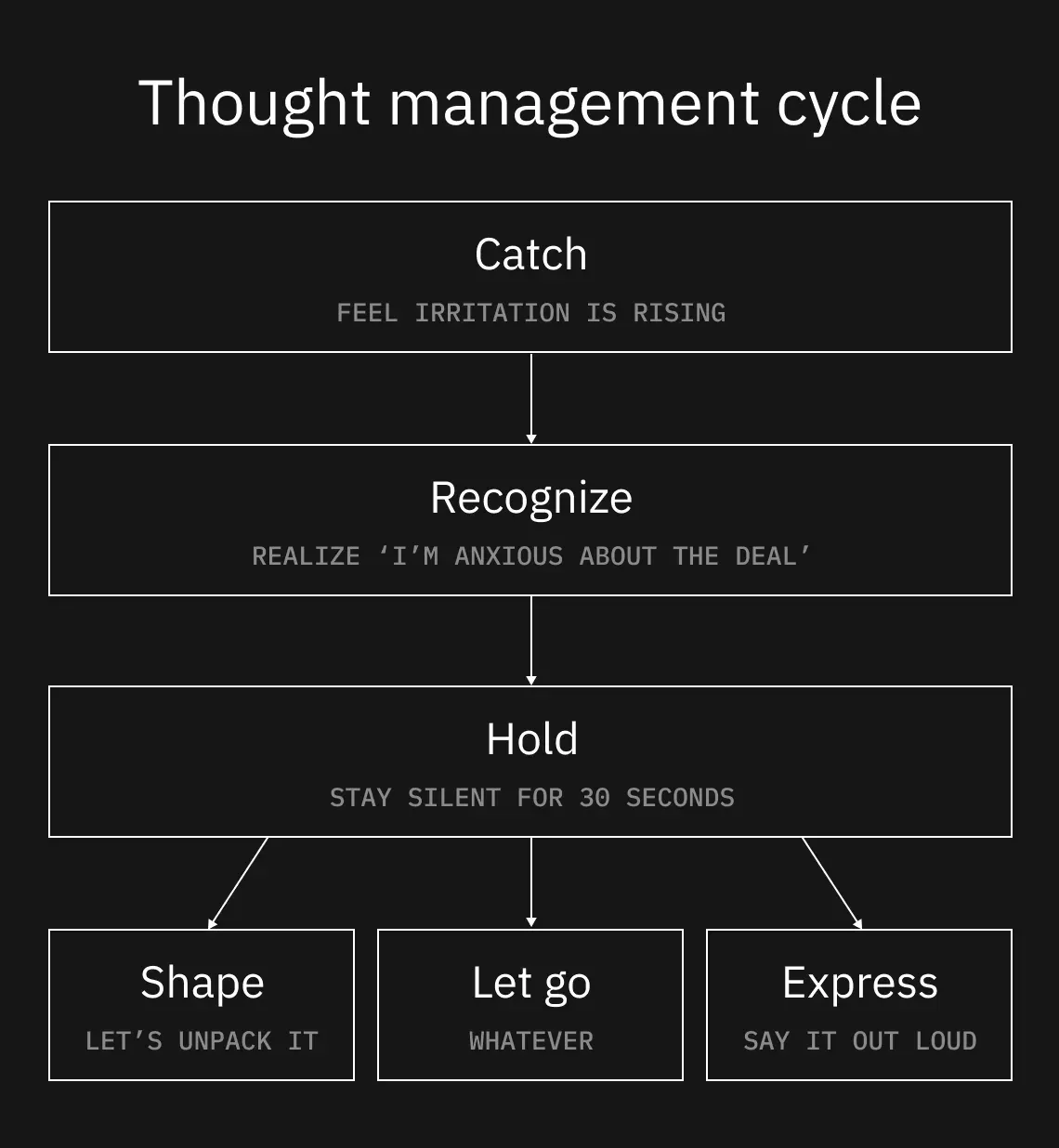
Sometimes catching a thought alone diffuses the situation.
Sometimes holding a thought leads to a breakthrough.
Sometimes you make it all the way from catching to recognizing, to holding and to expressing. Or letting go. Or shaping.
The more you practice slowing down, the more emotionally flexible, sensitive and responsive your mind becomes. That's where you enter stillness – first briefly and randomly, but more consciously and effortlessly as you keep practicing.
You can train the ability to slow down in countless ways — meditation, breathing, even just contemplating.
But the ability to slow down is only complete when it sets the rhythm of life.
Practice
Go gently, performance mode – off. You are retraining perception, not building a habit, and tension makes it harder to install. The end goal is to access stillness on demand so you can work with your thoughts and emotions much more effectively.
Duration: 7 / 14 / 30 days
Daily exercises:
- Catch one reactive thought. Write down a moment your mind fired before you chose. Log the trigger and the automatic response.
- Hold the gap. Once a day, pause before responding to a message, situation, urge, or anything that pulls your attention. Log the trigger and pause duration.
- Name the pull. When you feel an urge to act — check the phone, interrupt someone, switch tasks — don't. Instead, log the pull and what it promised.
- Two minutes of nothing. Sit without input. No screens, no tasks, no breathing techniques – nothing. Write down what came up. Rotate the context:
- Morning — before any screen or conversation.
- Mid-day — between tasks or after a meeting.
- Evening — after the day is done.